• Home
Results for {phrase} ({results_count} of {results_count_total})
Displaying {results_count} results of {results_count_total}

More results...

Filter by Product categories
Bioactive Molecules
Amino Acids, Peptides, Proteins
Carbohydrates
Lipids, Fatty Acids
Metabolites
Phytochemicals
Vitamins
Bioactive Small Molecules
Biopolymers
Detection in Bioanalysis
Fluorescent Detection
Organic Pollutants & Pesticides
Fungicides
Herbicides
Insecticides
Other Pollutants
Pharmaceutically Actives
Antibiotics
API's & Intermediates
Steroids
Reagents and Building Blocks
Reagents for Life Sciences
Buffers
Building Blocks, Intermediates, Reagents
Fluorescent Detection
Linker
Non Fluorescent Detection & Chromogene Detection
Quorum Sensing
Uncategorized
Unkategorisiert
    Industriestrasse 15, CH-9015 St. Gallen, Tel: +41 71 244 48 25
    • 0Shopping Cart
    Chemodex
    • Home
    • Products
    • Catalogs
    • About Chemodex
    • Contact & Distributors
    • Menu Menu
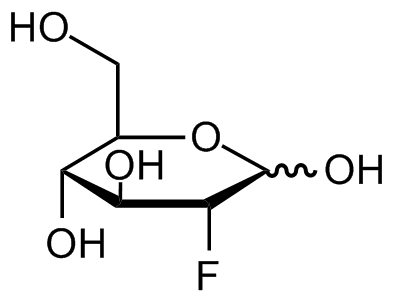
    2-Fluoro-2-deoxy-D-glucose

    Available from stock

      Inquiry

      Please fill out the form for your inquiry:


      * required field

      2-Fluoro-2-deoxy-D-glucose

      SKU
      F0076

      Categories:

      Synonyms
      2-Deoxy-2-fluoro-D-glucose , FDG , 2-FG , Fluorodeoxyglucose
      29702-43-0
      CAS-Number
      C6H11FO5
      Molecular Formula
      182.15
      Molecular Weight

      For Research Use Only. Not Intended for Diagnostic or Therapeutic Use.

      • Product Data
      • Handling
      • Safety Information
      • Details

      Specifications

      Purity
      ≥97% (NMR)
      Appearance
      White to yellow powder
      Identity
      1H-NMR

      Properties

      Solvents
      DMF (30 mg/ml), DMSO (30 mg/ml) or water (10 mg/ml).
      Melting Point
      174 - 176 °C
      Boiling Point
      478.4 °C (predicted)
      Density
      1.494 g/mL (predicted)
      Shipping
      AMBIENT
      Short Term Storage
      +4°C
      Long Term Storage
      -20°C
      Handling Advice
      Protect from light and moisture.
      Use / Stability
      Stable for at least 2 years after receipt when stored at -20°C.
      Hazard statements
      H315-H319-H335
      Precautionary statements
      P261-P305 + P351 + P338
      GHS Symbol
      GHS07
      Transportation
      Not dangerous goods
      Description
      2-Fluoro-2-deoxy-D-glucose [FDG] is a glucose analog that inhibits cellular glycosylation. It is the natural isotope-form of 18F-FDG that can be taken up by cells but does not undergo metabolic glycolysis. FDG uptake is closely related to the expression of the glucose transporter (GLUT) in malignant tumours. FDG is also a substrate of hexokinase isozymes and an inhibitor of cellular glycosylation. FDG is taken up by high-glucose-using cells such as brain, brown adipocytes, kidney and cancer cells, where phosphorylation prevents the glucose from being released again from the cell, once it has been absorbed. The 2-hydroxyl group (–OH) in normal glucose is needed for further glycolysis (metabolism of glucose by splitting it), but FDG is missing this 2-hydroxyl and cannot be further metabolized in cells. FDG is used in positron emission tomography (PET) as contrast agent and is the most widely used PET marker. FDG-PET can be used for diagnosis, staging, and monitoring treatment of cancers, particularly in Hodgkin's disease, non-Hodgkin lymphoma, colorectal cancer, breast cancer, melanoma, and lung cancer. FDG has also anticancer and chemosensitizing activity.
      Smiles
      O[C@H]1C(F)C(O)[C@H](O)[C@@H](CO)O1
      InChi Key
      ZCXUVYAZINUVJD-IVMDWMLBSA-N
      References
      (1) H. Minn, et al., Res. Exp. Med. 191, 27 (1991) , (2) Y. Kanazawa, et al., J. Neurochem. 66, 2113 (1996) , (3) T.J. Lampidis, et al., Cancer Chemother. Pharmacol. 58, 725 (2006) , (4) Y. Liu, et al., Prostate Cancer Prostatic Dis. 9, 230 (2006) , (5) Y. Pina, et al., Invest. Ophthalmol. Vis. Sci. 53, 996 (2012) , (6) A. Fantagare & A. Svatos, Front. Plant Sci. 7, 483 (2016) , (7) S. Niccoli, et al., PLosOne 12, e0187584 (2017) , (8) N. Hasnain, et al., J. Pak. Med. Assoc. 70, 2291 (2020)
      InChi
      InChI=1S/C6H11FO5/c7-3-5(10)4(9)2(1-8)12-6(3)11/h2-6,8-11H,1H2/t2-,3-,4-,5-,6?/m1/s1

      2-Fluoro-2-deoxy-D-glucose [FDG] is a glucose analog that inhibits cellular glycosylation. It is the natural isotope-form of 18F-FDG that can be taken up by cells but does not undergo metabolic glycolysis. FDG uptake is closely related to the expression of the glucose transporter (GLUT) in malignant tumours. FDG is also a substrate of hexokinase isozymes and an inhibitor of cellular glycosylation. FDG is taken up by high-glucose-using cells such as brain, brown adipocytes, kidney and cancer cells, where phosphorylation prevents the glucose from being released again from the cell, once it has been absorbed. The 2-hydroxyl group (–OH) in normal glucose is needed for further glycolysis (metabolism of glucose by splitting it), but FDG is missing this 2-hydroxyl and cannot be further metabolized in cells. FDG is used in positron emission tomography (PET) as contrast agent and is the most widely used PET marker. FDG-PET can be used for diagnosis, staging, and monitoring treatment of cancers, particularly in Hodgkin’s disease, non-Hodgkin lymphoma, colorectal cancer, breast cancer, melanoma, and lung cancer. FDG has also anticancer and chemosensitizing activity.

      SKU: F0076
      • Additional information

      Additional information

      Synonyms

      2-Deoxy-2-fluoro-D-glucose, FDG, 2-FG, Fluorodeoxyglucose

      Purity

      ≥97% (NMR)

      Appearance

      White to yellow powder

      CAS-Number

      29702-43-0

      Molecular Formula

      C6H11FO5

      Molecular Weight

      182.15

      Identity

      1H-NMR

      Solvents

      DMF (30 mg/ml), DMSO (30 mg/ml) or water (10 mg/ml).

      Melting Point

      174 – 176 °C

      Boiling Point

      478.4 °C (predicted)

      Density

      1.494 g/mL (predicted)

      Smiles

      O[C@H]1C(F)C(O)[C@H](O)[C@@H](CO)O1

      InChi Key

      ZCXUVYAZINUVJD-IVMDWMLBSA-N

      Shipping

      AMBIENT

      Short Term Storage

      +4°C

      Long Term Storage

      -20°C

      Handling Advice

      Protect from light and moisture.

      Use / Stability

      Stable for at least 2 years after receipt when stored at -20°C.

      Hazard statements

      H315-H319-H335

      Precautionary statements

      P261-P305 + P351 + P338

      GHS Symbol

      GHS07

      Transportation

      Not dangerous goods

      References

      (1) H. Minn, et al., Res. Exp. Med. 191, 27 (1991), (2) Y. Kanazawa, et al., J. Neurochem. 66, 2113 (1996), (3) T.J. Lampidis, et al., Cancer Chemother. Pharmacol. 58, 725 (2006), (4) Y. Liu, et al., Prostate Cancer Prostatic Dis. 9, 230 (2006), (5) Y. Pina, et al., Invest. Ophthalmol. Vis. Sci. 53, 996 (2012), (6) A. Fantagare & A. Svatos, Front. Plant Sci. 7, 483 (2016), (7) S. Niccoli, et al., PLosOne 12, e0187584 (2017), (8) N. Hasnain, et al., J. Pak. Med. Assoc. 70, 2291 (2020)

      InChi

      InChI=1S/C6H11FO5/c7-3-5(10)4(9)2(1-8)12-6(3)11/h2-6,8-11H,1H2/t2-,3-,4-,5-,6?/m1/s1

      Quantity

      25 mg, 100 mg, Bulk

      © Copyright - Chemodex AG - Customized Molecules developed in Switzerland
      • Home
      • All products
      • Order and delivery information
      • Disclaimer
      • Privacy policy
      • About this site
      5-[(4-Ethylphenyl)methylene]-2-thioxo-4-thiazolidinone5-[(4-Ethylphenyl)methylene]-2-thioxo-4-thiazolidinoneFluorescein dicaproateFluorescein dicaproate Scroll to top