• Home
Results for {phrase} ({results_count} of {results_count_total})
Displaying {results_count} results of {results_count_total}

More results...

Filter by Product categories
Bioactive Molecules
Amino Acids, Peptides, Proteins
Carbohydrates
Lipids, Fatty Acids
Metabolites
Phytochemicals
Vitamins
Bioactive Small Molecules
Biopolymers
Detection in Bioanalysis
Fluorescent Detection
Organic Pollutants & Pesticides
Fungicides
Herbicides
Insecticides
Other Pollutants
Pharmaceutically Actives
Antibiotics
API's & Intermediates
Steroids
Reagents and Building Blocks
Reagents for Life Sciences
Buffers
Building Blocks, Intermediates, Reagents
Fluorescent Detection
Linker
Non Fluorescent Detection & Chromogene Detection
Quorum Sensing
Uncategorized
Unkategorisiert
    Industriestrasse 15, CH-9015 St. Gallen, Tel: +41 71 244 48 25
    • 0Shopping Cart
    Chemodex
    • Home
    • Products
    • Catalogs
    • About Chemodex
    • Contact & Distributors
    • Menu Menu
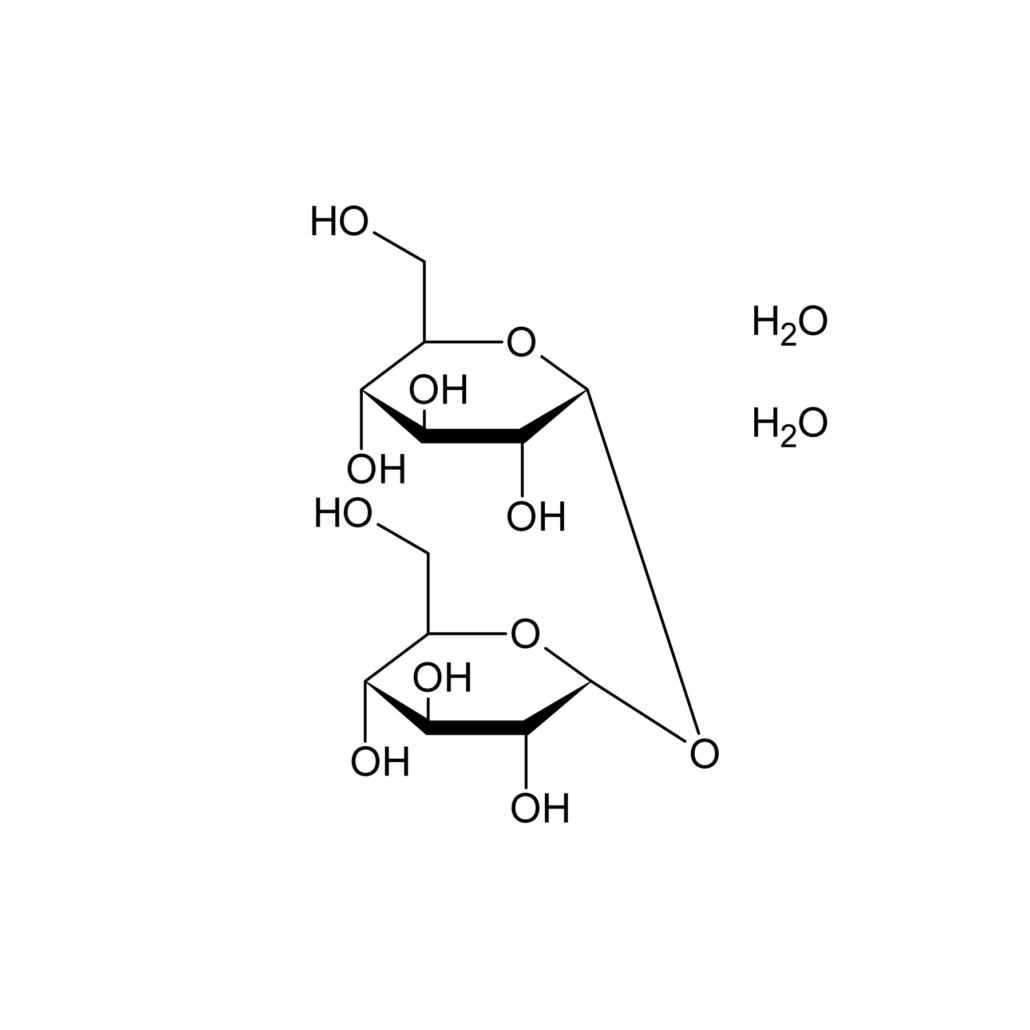
    D-(+)-Trehalose dihydrate

    Available from stock

      Inquiry

      Please fill out the form for your inquiry:


      * required field

      D-(+)-Trehalose dihydrate

      SKU
      T0202

      Category: Carbohydrates

      Synonyms
      alp,α-Trehalose , α-D-Glucopyranosyl-α-D-glucopyranoside , Trehalose dihydrate
      6138-23-4
      CAS-Number
      C12H22O11 · 2H2O
      Molecular Formula
      378.33
      Molecular Weight

      For Research Use Only. Not Intended for Diagnostic or Therapeutic Use.

      • Product Data
      • Handling
      • Safety Information
      • Details

      Specifications

      Purity
      ≥99%
      Appearance
      White powder
      Identity
      1H-NMR

      Properties

      Solvents
      water (50 mg/ml)
      Melting Point
      97-99 °C

      Documentation

      Safety Data Sheet (SDS)
      CDX T0202 MSDS.pdf
      Shipping
      AMBIENT
      Short Term Storage
      RT
      Long Term Storage
      +4°C
      Handling Advice
      Protect from light and moisture.
      Use / Stability
      Stable for at least 2 years after receipt when stored at +4°C.
      Transportation
      Not dangerous goods
      Description
      Natural alpha-linked disaccharide formed by alpha-glucose units. Can be synthesized by bacteria, fungi, plants and invertebrate animals. It is implicated in anhydrobiosis, the ability of plants and animals to withstand prolonged periods of desiccation/dehydration. The sugar is thought to form a gel phase as cells dehydrate, which prevents disruption of internal cell organelles. Rehydration then allows normal cellular activity to be resumed without the major, lethal damage that would normally follow a dehydration/rehydration cycle. It has high water retention capabilities, and is used in food and cosmetics. Used as a cryoprotectant in a variety of cell freezing media, in solid dosage formulations, most notably in quick-dissolving tablets and to preserve foods, enzymes, vaccines, cells in a dehydrated state at room temperature. Major carbohydrate energy storage molecule used by insects for flight. Osmolyte, a chemical chaperone and inducer of autophagy, that has been reported to protect cells against numerous environmental stresses. This compound contains many properties that allow it to stabilize partially unfolded protein molecules and inhibit protein aggregation.
      Smiles
      OC[C@@H]1[C@@H](O)[C@H](O)[C@@H](O)[C@@H](O[C@@H]2[C@H](O)[C@@H](O)[C@H](O)[C@@H](CO)O2)O1.O.O
      InChi Key
      DPVHGFAJLZWDOC-PVXXTIHASA-N
      References
      J.H. Crowe, Adv. Exp. Med. Biol. 594, 143 (2007) , N.K. Jain & I. Roy, Protein Sci. 18, 24 (2009) , G. Iturriaga, et al., Int. J. Mol. Sci. 10, 3793 (2009) , S. Ohtake & Y.J. Wang, J. Pharm. Sci. 100, 2020 (2011) , P.L. Chiu, et al., Micron. 42, 762 (2011) , E. Emanuele, Curr. Drug Targets. 15, 551 (2014) , P. Mardones, et al., Sci. Signal. 9, 416 (2016)
      InChi
      InChI=1S/C12H22O11.2H2O/c13-1-3-5(15)7(17)9(19)11(21-3)23-12-10(20)8(18)6(16)4(2-14)22-12,,/h3-20H,1-2H2,2*1H2/t3-,4-,5-,6-,7+,8+,9-,10-,11-,12-,,/m1../s1

      Natural alpha-linked disaccharide formed by alpha-glucose units. Can be synthesized by bacteria, fungi, plants and invertebrate animals. It is implicated in anhydrobiosis, the ability of plants and animals to withstand prolonged periods of desiccation/dehydration. The sugar is thought to form a gel phase as cells dehydrate, which prevents disruption of internal cell organelles. Rehydration then allows normal cellular activity to be resumed without the major, lethal damage that would normally follow a dehydration/rehydration cycle. It has high water retention capabilities, and is used in food and cosmetics. Used as a cryoprotectant in a variety of cell freezing media, in solid dosage formulations, most notably in quick-dissolving tablets and to preserve foods, enzymes, vaccines, cells in a dehydrated state at room temperature. Major carbohydrate energy storage molecule used by insects for flight. Osmolyte, a chemical chaperone and inducer of autophagy, that has been reported to protect cells against numerous environmental stresses. This compound contains many properties that allow it to stabilize partially unfolded protein molecules and inhibit protein aggregation.

      SKU: T0202 Category: Carbohydrates
      • Additional information

      Additional information

      Synonyms

      alp,α-Trehalose, α-D-Glucopyranosyl-α-D-glucopyranoside, Trehalose dihydrate

      Purity

      ≥99%

      Appearance

      White powder

      CAS-Number

      6138-23-4

      Molecular Formula

      C12H22O11 · 2H2O

      Molecular Weight

      378.33

      Identity

      1H-NMR

      Solvents

      water (50 mg/ml)

      Melting Point

      97-99 °C

      Smiles

      OC[C@@H]1[C@@H](O)[C@H](O)[C@@H](O)[C@@H](O[C@@H]2[C@H](O)[C@@H](O)[C@H](O)[C@@H](CO)O2)O1.O.O

      InChi Key

      DPVHGFAJLZWDOC-PVXXTIHASA-N

      Shipping

      AMBIENT

      Short Term Storage

      RT

      Long Term Storage

      +4°C

      Handling Advice

      Protect from light and moisture.

      Use / Stability

      Stable for at least 2 years after receipt when stored at +4°C.

      Transportation

      Not dangerous goods

      References

      J.H. Crowe, Adv. Exp. Med. Biol. 594, 143 (2007), N.K. Jain & I. Roy, Protein Sci. 18, 24 (2009), G. Iturriaga, et al., Int. J. Mol. Sci. 10, 3793 (2009), S. Ohtake & Y.J. Wang, J. Pharm. Sci. 100, 2020 (2011), P.L. Chiu, et al., Micron. 42, 762 (2011), E. Emanuele, Curr. Drug Targets. 15, 551 (2014), P. Mardones, et al., Sci. Signal. 9, 416 (2016)

      InChi

      InChI=1S/C12H22O11.2H2O/c13-1-3-5(15)7(17)9(19)11(21-3)23-12-10(20)8(18)6(16)4(2-14)22-12,,/h3-20H,1-2H2,2*1H2/t3-,4-,5-,6-,7+,8+,9-,10-,11-,12-,,/m1../s1

      Quantity

      25 g, 100 g, 500 g, Bulk

      Related products

      • beta-Cyclodextrin

        beta-Cyclodextrin

        Purity: ≥98% (dry basis)CAS-Number: 7585-39-9SKU: C0261

        Read more Show Details
      • Isoorientin

        Isoorientin

        Purity: ≥98% (HPLC)CAS-Number: 4261-42-1SKU: I0095

        Read more Show Details
      • D-(+)-Xylose

        D-(+)-Xylose

        Purity: ≥98.5% (HPLC)CAS-Number: 58-86-6SKU: X0013

        Read more Show Details
      • L-(+)-Arabinose

        L-(+)-Arabinose

        Purity: ≥99% (HPLC)CAS-Number: 5328-37-0SKU: A0410

        Read more Show Details
      © Copyright - Chemodex AG - Customized Molecules developed in Switzerland
      • Home
      • All products
      • Order and delivery information
      • Disclaimer
      • Privacy policy
      • About this site
      Tamoxifen citrate saltTamoxifen citrate saltTerbinafine hydrochlorideTerbinafine hydrochloride Scroll to top