• Home
Results for {phrase} ({results_count} of {results_count_total})
Displaying {results_count} results of {results_count_total}

More results...

Filter by Product categories
Bioactive Molecules
Amino Acids, Peptides, Proteins
Carbohydrates
Lipids, Fatty Acids
Metabolites
Phytochemicals
Vitamins
Bioactive Small Molecules
Biopolymers
Detection in Bioanalysis
Fluorescent Detection
Organic Pollutants & Pesticides
Fungicides
Herbicides
Insecticides
Other Pollutants
Pharmaceutically Actives
Antibiotics
API's & Intermediates
Steroids
Reagents and Building Blocks
Reagents for Life Sciences
Buffers
Building Blocks, Intermediates, Reagents
Fluorescent Detection
Linker
Non Fluorescent Detection & Chromogene Detection
Quorum Sensing
Uncategorized
    Industriestrasse 15, CH-9015 St. Gallen, Tel: +41 71 244 48 25
    • 0Shopping Cart
    Chemodex
    • Home
    • Products
    • Catalogs
    • About Chemodex
    • Contact & Distributors
    • Menu Menu
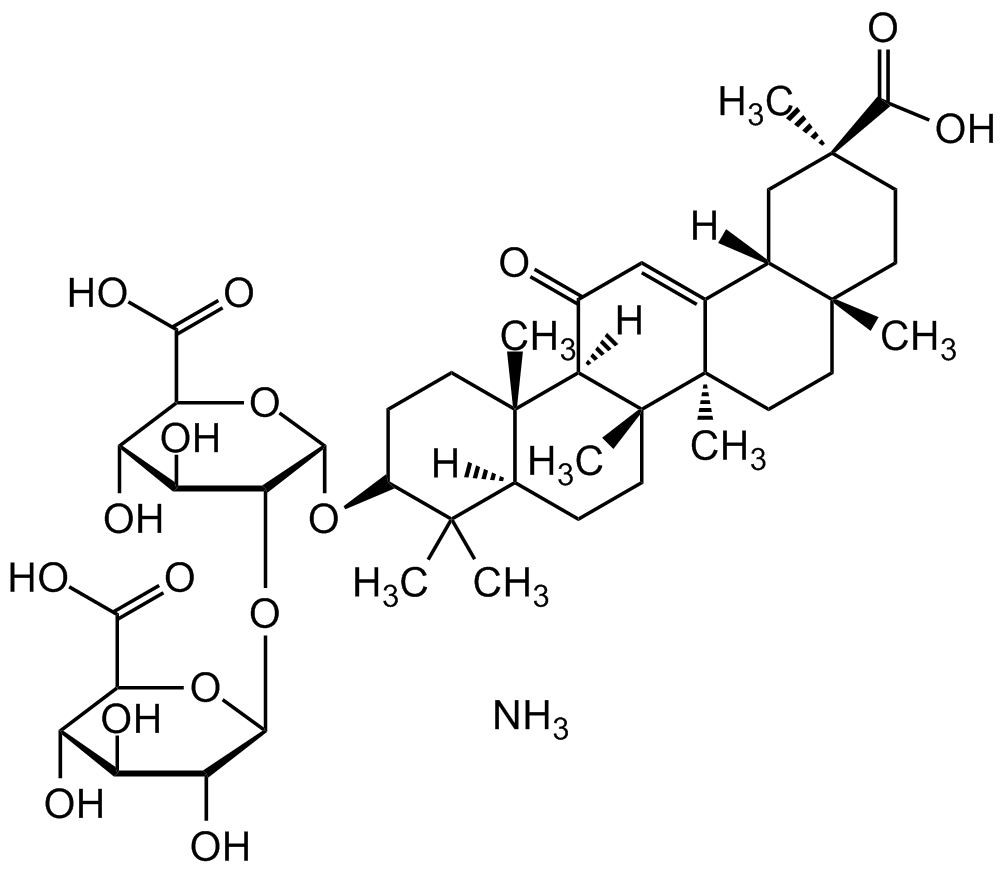
    Glycyrrhizic acid ammonium salt

    Available from stock

      Inquiry

      Please fill out the form for your inquiry:


      * required field

      Glycyrrhizic acid ammonium salt

      SKU
      G0215

      Category: Phytochemicals

      Synonyms
      Glycyrrhizin , 3-O-(2-O-β-D-Glucopyranuronosyl-α-D-glucopyranuronosyl)-18β-glycyrrhetinic acid ammonium salt , Monoammonium glycyrrhizinate , NSC 2800 , NSC 35348
      53956-04-0
      CAS-Number
      C42H62O16 . NH3
      Molecular Formula
      839.96
      Molecular Weight

      For Research Use Only. Not Intended for Diagnostic or Therapeutic Use.

      • Product Data
      • Handling
      • Safety Information
      • Details

      Specifications

      Purity
      ≥98% (Titr.)
      Appearance
      White powder
      Identity
      1H-NMR

      Properties

      Solvents
      DMSO (10 mg/ml), water (1 mg/ml)
      Melting Point
      209-211° C
      Optical Activity
      [a]20/D +48±4°, c = 1% in ethanol: water (1:1)

      Documentation

      Safety Data Sheet (SDS)
      CDX G0215 MSDS.pdf
      Shipping
      AMBIENT
      Short Term Storage
      RT
      Long Term Storage
      +4°C
      Handling Advice
      Protect from light and moisture.
      Use / Stability
      Stable for at least 2 years after receipt when stored at +4°C.
      Transportation
      Not dangerous goods
      Description
      Glycyrrhizic acid is a natural triterpenoid saponin. It is an agonist of the human sweet taste receptor and is used as a flavorant. Glycyrrhizic acid has diverse biological activities, including antioxidant, anti-inflammatory, antidiabetic, anticancer, antimicrobial, hepatoprotective, neuroprotective and antiviral actions. Glycyrrhizic acid has been shown to be a 11-β-hydroxysteroid dehydrogenase inhibitor, a functional inhibitor of HMGB1 and a highly selective and competitive inhibitor of kynurenine aminotransferase 2 (KAT2). It can enhance GLP-1 secretion through TGR5 activation and has an anti-inflammatory effect by attenuating the generation of excessive NO, PGE(2), and ROS and by suppressing the expression of pro-inflammatory genes through the inhibition of NF-?B and PI3K activity. It has anti-angiogenic and apoptosis inducing properties. In addition, due to its amphiphilic nature glycyrrhizic acid is able to form self-associates in aqueous and non-aqueous media, as well as water soluble complexes with a wide range of lipophilic drugs. It has been identified as promising carrier material for anticancer therapy, due to its anti-cancer-related pharmacological activities, such as broad-spectrum anti-cancer ability, resistance to the tissue toxicity caused by chemotherapy and radiation, drug absorption enhancing effects and anti-multidrug resistance (MDR) mechanisms.
      Smiles
      O=C(O)[C@@H]1[C@@H](O)[C@H](O)[C@@H](O)[C@H](O[C@@H]2[C@@H](O)[C@H](O)[C@@H](C(O)=O)O[C@@H]2O[C@H]3C(C)(C)[C@@](CC[C@]([C@@](CC[C@]4(C)[C@@]5([H])C[C@@](C)(C(O)=O)CC4)(C)C5=C6)(C)[C@]7([H])C6=O)([H])[C@]7(C)CC3)O1.N
      InChi Key
      ILRKKHJEINIICQ-IERXZFCASA-N
      References
      (1) R. Pompei, et al., Experientia 36, 304 (1980) , (2) N.M. Gandhi, et al., J. Radiat. Res. 45, 461 (2004) , (3) C.Y. Wang, et al., J. Agric. Food Chem. 59, 7726 (2011) , (4) Y.Y. Chia, et al., Eur. J. Pharmacol. 677, 197 (2012) , (5) K.J. Kim, et al., Phytother. Res. 27, 841 (2013) , (6) F.S. Chueh, et al., Oncol. Rep. 28, 2069 (2012) , (7) E.S. Ramli, et al., J. Bone Miner. Metab. 31, 262 (2013) , (8) L.J. Ming & A.C. Yin, Nat. Prod. Commun. 8, 415 (2013) (Review) , (9) A. Lau, et al., Am. J. Nephrol. 40, 84 (2014) , (10) H.S. Cheng, et al., Nat. Prod. Bioprospect. 4, 325 (2014) , (11) Y. Ohtsu, et al., Mol. Cell. Endocrinol. 394, 70 (2014) , (12) L. Wang, et al., Acta Pharmac. Sin. B 5, 310 (2015) , (13) S. Ojha, et al., Neurotox. Res. 29, 275 (2016) , (14) L.Y. Wang, et al., Biomed. Pharmacother. 95, 599 (2017) , (15) Z.G. Sun, et al., Mini Rev. Med. Chem. 19, 826 (2019) (Review) , (16) O.Y. Selyutina & N.E. Polyakov, Int. J. Pharm. 559, 271 (2019) (Review) , (17) Y. Yoshida, et al., Sci. Rep. 9, 10243 (2019)
      InChi
      InChI=1S/C42H62O16.H3N/c1-37(2)21-8-11-42(7)31(20(43)16-18-19-17-39(4,36(53)54)13-12-38(19,3)14-15-41(18,42)6)40(21,5)10-9-22(37)55-35-30(26(47)25(46)29(57-35)33(51)52)58-34-27(48)23(44)24(45)28(56-34)32(49)50,/h16,19,21-31,34-35,44-48H,8-15,17H2,1-7H3,(H,49,50)(H,51,52)(H,53,54),1H3/t19-,21-,22+,23-,24-,25-,26-,27+,28-,29-,30+,31+,34-,35-,38+,39-,40-,41+,42+,/m0./s1

      Glycyrrhizic acid is a natural triterpenoid saponin. It is an agonist of the human sweet taste receptor and is used as a flavorant. Glycyrrhizic acid has diverse biological activities, including antioxidant, anti-inflammatory, antidiabetic, anticancer, antimicrobial, hepatoprotective, neuroprotective and antiviral actions. Glycyrrhizic acid has been shown to be a 11-β-hydroxysteroid dehydrogenase inhibitor, a functional inhibitor of HMGB1 and a highly selective and competitive inhibitor of kynurenine aminotransferase 2 (KAT2). It can enhance GLP-1 secretion through TGR5 activation and has an anti-inflammatory effect by attenuating the generation of excessive NO, PGE(2), and ROS and by suppressing the expression of pro-inflammatory genes through the inhibition of NF-?B and PI3K activity. It has anti-angiogenic and apoptosis inducing properties. In addition, due to its amphiphilic nature glycyrrhizic acid is able to form self-associates in aqueous and non-aqueous media, as well as water soluble complexes with a wide range of lipophilic drugs. It has been identified as promising carrier material for anticancer therapy, due to its anti-cancer-related pharmacological activities, such as broad-spectrum anti-cancer ability, resistance to the tissue toxicity caused by chemotherapy and radiation, drug absorption enhancing effects and anti-multidrug resistance (MDR) mechanisms.

      SKU: G0215 Category: Phytochemicals
      • Additional information

      Additional information

      Synonyms

      Glycyrrhizin, 3-O-(2-O-β-D-Glucopyranuronosyl-α-D-glucopyranuronosyl)-18β-glycyrrhetinic acid ammonium salt, Monoammonium glycyrrhizinate, NSC 2800, NSC 35348

      Purity

      ≥98% (Titr.)

      Appearance

      White powder

      CAS-Number

      53956-04-0

      Molecular Formula

      C42H62O16 . NH3

      Molecular Weight

      839.96

      Identity

      1H-NMR

      Solvents

      DMSO (10 mg/ml), water (1 mg/ml)

      Melting Point

      209-211° C

      Optical Activity

      [a]20/D +48±4°, c = 1% in ethanol: water (1:1)

      Smiles

      O=C(O)[C@@H]1[C@@H](O)[C@H](O)[C@@H](O)[C@H](O[C@@H]2[C@@H](O)[C@H](O)[C@@H](C(O)=O)O[C@@H]2O[C@H]3C(C)(C)[C@@](CC[C@]([C@@](CC[C@]4(C)[C@@]5([H])C[C@@](C)(C(O)=O)CC4)(C)C5=C6)(C)[C@]7([H])C6=O)([H])[C@]7(C)CC3)O1.N

      InChi Key

      ILRKKHJEINIICQ-IERXZFCASA-N

      Shipping

      AMBIENT

      Short Term Storage

      RT

      Long Term Storage

      +4°C

      Handling Advice

      Protect from light and moisture.

      Use / Stability

      Stable for at least 2 years after receipt when stored at +4°C.

      Transportation

      Not dangerous goods

      References

      (1) R. Pompei, et al., Experientia 36, 304 (1980), (2) N.M. Gandhi, et al., J. Radiat. Res. 45, 461 (2004), (3) C.Y. Wang, et al., J. Agric. Food Chem. 59, 7726 (2011), (4) Y.Y. Chia, et al., Eur. J. Pharmacol. 677, 197 (2012), (5) K.J. Kim, et al., Phytother. Res. 27, 841 (2013), (6) F.S. Chueh, et al., Oncol. Rep. 28, 2069 (2012), (7) E.S. Ramli, et al., J. Bone Miner. Metab. 31, 262 (2013), (8) L.J. Ming & A.C. Yin, Nat. Prod. Commun. 8, 415 (2013) (Review), (9) A. Lau, et al., Am. J. Nephrol. 40, 84 (2014), (10) H.S. Cheng, et al., Nat. Prod. Bioprospect. 4, 325 (2014), (11) Y. Ohtsu, et al., Mol. Cell. Endocrinol. 394, 70 (2014), (12) L. Wang, et al., Acta Pharmac. Sin. B 5, 310 (2015), (13) S. Ojha, et al., Neurotox. Res. 29, 275 (2016), (14) L.Y. Wang, et al., Biomed. Pharmacother. 95, 599 (2017), (15) Z.G. Sun, et al., Mini Rev. Med. Chem. 19, 826 (2019) (Review), (16) O.Y. Selyutina & N.E. Polyakov, Int. J. Pharm. 559, 271 (2019) (Review), (17) Y. Yoshida, et al., Sci. Rep. 9, 10243 (2019)

      InChi

      InChI=1S/C42H62O16.H3N/c1-37(2)21-8-11-42(7)31(20(43)16-18-19-17-39(4,36(53)54)13-12-38(19,3)14-15-41(18,42)6)40(21,5)10-9-22(37)55-35-30(26(47)25(46)29(57-35)33(51)52)58-34-27(48)23(44)24(45)28(56-34)32(49)50,/h16,19,21-31,34-35,44-48H,8-15,17H2,1-7H3,(H,49,50)(H,51,52)(H,53,54),1H3/t19-,21-,22+,23-,24-,25-,26-,27+,28-,29-,30+,31+,34-,35-,38+,39-,40-,41+,42+,/m0./s1

      Quantity

      25 g, 100 g, Bulk

      Related products

      • Cantharidin

        Cantharidin

        Purity: ≥98% (HPLC)CAS-Number: 56-25-7SKU: C0643

        Read more Show Details
      • Hydroxytyrosol

        Hydroxytyrosol

        Purity: ≥98% (HPLC)CAS-Number: 10597-60-1SKU: H0155

        Read more Show Details
      • Pyridoxal hydrochloride

        Pyridoxal hydrochloride

        Purity: ≥98% (Argentometric Titration)CAS-Number: 65-22-5SKU: P0118

        Read more Show Details
      • Nordihydrocapsiate

        Nordihydrocapsiate

        Purity: ≥95% (HPLC)CAS-Number: 220012-53-3SKU: N0121

        Read more Show Details
      © Copyright - Chemodex AG - Customized Molecules developed in Switzerland
      • Home
      • All products
      • Order and delivery information
      • Disclaimer
      • Privacy policy
      • About this site
      D-Glucuronic acidD-Glucuronic acidGalanginGalangin Scroll to top