• Home
Results for {phrase} ({results_count} of {results_count_total})
Displaying {results_count} results of {results_count_total}

More results...

Filter by Product categories
Bioactive Molecules
Amino Acids, Peptides, Proteins
Carbohydrates
Lipids, Fatty Acids
Metabolites
Phytochemicals
Vitamins
Bioactive Small Molecules
Biopolymers
Detection in Bioanalysis
Fluorescent Detection
Organic Pollutants & Pesticides
Fungicides
Herbicides
Insecticides
Other Pollutants
Pharmaceutically Actives
Antibiotics
API's & Intermediates
Steroids
Reagents and Building Blocks
Reagents for Life Sciences
Buffers
Building Blocks, Intermediates, Reagents
Fluorescent Detection
Linker
Non Fluorescent Detection & Chromogene Detection
Quorum Sensing
Uncategorized
    Industriestrasse 15, CH-9015 St. Gallen, Tel: +41 71 244 48 25
    • 0Shopping Cart
    Chemodex
    • Home
    • Products
    • Catalogs
    • About Chemodex
    • Contact & Distributors
    • Menu Menu
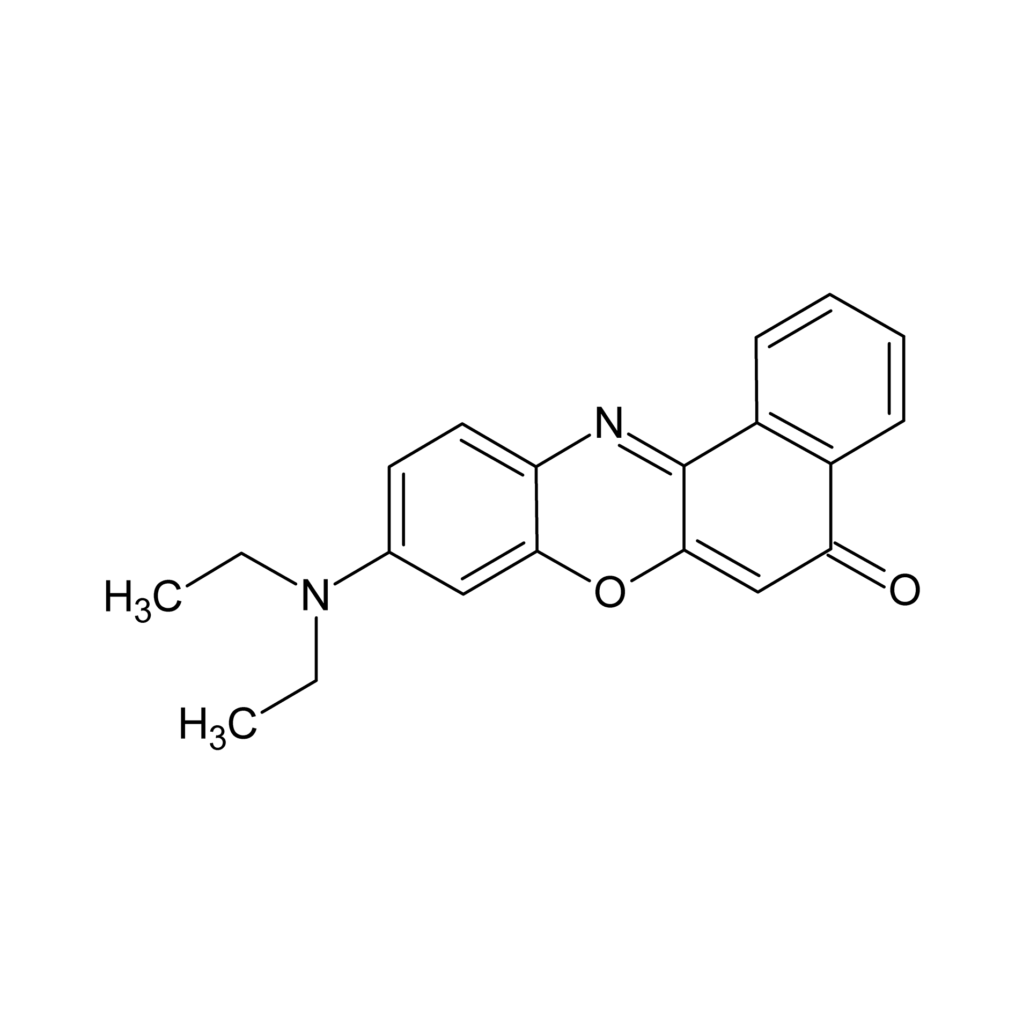
    Nile Red

    Available from stock

      Inquiry

      Please fill out the form for your inquiry:


      * required field

      Nile Red

      SKU
      N0107

      Categories: Fluorescent Detection, Fluorescent Detection

      Synonyms
      Nile Blue A Oxazone , Phenoxazone 9 , 9-(Diethylamino)-5H-benzo[a]phenoxazin-5-one
      7385-67-3
      CAS-Number
      C20H18N2O2
      Molecular Formula
      318.4
      Molecular Weight

      For Research Use Only. Not Intended for Diagnostic or Therapeutic Use.

      • Product Data
      • Handling
      • Safety Information
      • Details

      Specifications

      Purity
      ≥98% (HPLC)
      Appearance
      Green to brown powder
      Identity
      1H-NMR

      Properties

      Solvents
      chloroform
      Shipping
      AMBIENT
      Short Term Storage
      +4°C
      Long Term Storage
      -20°C
      Handling Advice
      Protect from light and moisture.
      Use / Stability
      Stable for at least 2 years after receipt when stored at -20°C.
      Transportation
      Not dangerous goods
      Description
      Uncharged, hydrophobic, photostable fluorescent probe that strongly fluoresces bright red in hydrophobic (lipid-rich) environments, but is almost nonfluorescent in water. This lipophilic stain is commonly used for the detection of intracellular lipid droplets in cells such as adipocytes by fluorescence microscopy and flow cytometry. It has been shown to detect the exposure or formation of new hydrophobic surfaces induced by ligand binding to calmodulin, oligomerization of melittin, or unfolding of ovalbumin during early thermal denaturation. This product has been employed to stain cell structures, as well as to visualize and localize colloidal drug carriers. Has been used to stain lipophilic proteins that have been separated by SDS-PAGE electrophoresis or to detect sphingolipids on thin-layer chromatograms. The fluorescence is unaffected between pH 4.5 and 8.5 and may be used in dilute concentrations to investigate hydrophobic protein sites. Spectral properties: Intracellular fat vacuoles, filled with neutral lipids such as cholesterol, lipoproteins and triglycerides will fluoresce green (Abs/Em =485/525) while polar lipids, such as phospholipids, will fluoresce red (Abs/Em = 552/636 nm).
      Smiles
      CCN(CC)C1=CC=C2N=C3C(OC2=C1)=CC(=O)C1=C3C=CC=C1
      InChi Key
      VOFUROIFQGPCGE-UHFFFAOYSA-N
      References
      (1) P. Greenspan, et al.: J. Cell Biol. 100, 965 (1985) , (2) S.D. Fowler & P. Greenspan: J. Histochem. Cytochem. 33, 833 (1985) , (3) D.L. Sackett & J. Wolff: Anal. Biochem. 167, 228 (1987) , (4) F.J. Alba, et al: Biotechniques 21, 625 (1996) , (5) A. Lamprecht, et al.: J. Chromatogr. B Analyt. Technol. Biomed. Life Sci. 787, 415 (2003) , (6) A. Makino, et al.: Biochem. 45, 4530 (2006) , (7) T. Werner, et al.: Cytometry A 69, 200 (2006) , (8) B.W. Halstead, et al.: J. Appl. Toxicol. 26, 169 (2006) , (9) R. Varghese, et al.: Chemistry 16, 9040 (2010)
      InChi
      InChI=1S/C20H18N2O2/c1-3-22(4-2)13-9-10-16-18(11-13)24-19-12-17(23)14-7-5-6-8-15(14)20(19)21-16/h5-12H,3-4H2,1-2H3

      Uncharged, hydrophobic, photostable fluorescent probe that strongly fluoresces bright red in hydrophobic (lipid-rich) environments, but is almost nonfluorescent in water. This lipophilic stain is commonly used for the detection of intracellular lipid droplets in cells such as adipocytes by fluorescence microscopy and flow cytometry. It has been shown to detect the exposure or formation of new hydrophobic surfaces induced by ligand binding to calmodulin, oligomerization of melittin, or unfolding of ovalbumin during early thermal denaturation. This product has been employed to stain cell structures, as well as to visualize and localize colloidal drug carriers. Has been used to stain lipophilic proteins that have been separated by SDS-PAGE electrophoresis or to detect sphingolipids on thin-layer chromatograms. The fluorescence is unaffected between pH 4.5 and 8.5 and may be used in dilute concentrations to investigate hydrophobic protein sites. Spectral properties: Intracellular fat vacuoles, filled with neutral lipids such as cholesterol, lipoproteins and triglycerides will fluoresce green (Abs/Em =485/525) while polar lipids, such as phospholipids, will fluoresce red (Abs/Em = 552/636 nm).

      SKU: N0107 Categories: Fluorescent Detection, Fluorescent Detection
      • Additional information

      Additional information

      Synonyms

      Nile Blue A Oxazone, Phenoxazone 9, 9-(Diethylamino)-5H-benzo[a]phenoxazin-5-one

      Purity

      ≥98% (HPLC)

      Appearance

      Green to brown powder

      CAS-Number

      7385-67-3

      Molecular Formula

      C20H18N2O2

      Molecular Weight

      318.4

      Identity

      1H-NMR

      Solvents

      chloroform

      Smiles

      CCN(CC)C1=CC=C2N=C3C(OC2=C1)=CC(=O)C1=C3C=CC=C1

      InChi Key

      VOFUROIFQGPCGE-UHFFFAOYSA-N

      Shipping

      AMBIENT

      Short Term Storage

      +4°C

      Long Term Storage

      -20°C

      Handling Advice

      Protect from light and moisture.

      Use / Stability

      Stable for at least 2 years after receipt when stored at -20°C.

      Transportation

      Not dangerous goods

      References

      (1) P. Greenspan, et al.: J. Cell Biol. 100, 965 (1985), (2) S.D. Fowler & P. Greenspan: J. Histochem. Cytochem. 33, 833 (1985), (3) D.L. Sackett & J. Wolff: Anal. Biochem. 167, 228 (1987), (4) F.J. Alba, et al: Biotechniques 21, 625 (1996), (5) A. Lamprecht, et al.: J. Chromatogr. B Analyt. Technol. Biomed. Life Sci. 787, 415 (2003), (6) A. Makino, et al.: Biochem. 45, 4530 (2006), (7) T. Werner, et al.: Cytometry A 69, 200 (2006), (8) B.W. Halstead, et al.: J. Appl. Toxicol. 26, 169 (2006), (9) R. Varghese, et al.: Chemistry 16, 9040 (2010)

      InChi

      InChI=1S/C20H18N2O2/c1-3-22(4-2)13-9-10-16-18(11-13)24-19-12-17(23)14-7-5-6-8-15(14)20(19)21-16/h5-12H,3-4H2,1-2H3

      Quantity

      1 g, 5 g, Bulk

      Related products

      • 6-Amino TAMRA

        6-Amino TAMRA

        Purity: ≥97% (HPLC)CAS-Number: 159435-10-6SKU: A0157

        Read more Show Details
      • DAF-FM

        DAF-FM

        Purity: ≥98% (HPLC)CAS-Number: 254109-20-1SKU: A0023

        Read more Show Details
      • AMCA-X

        AMCA-X

        Purity: ≥95% (HPLC)CAS-Number: 205124-69-2SKU: A0073

        Read more Show Details
      • NBD-amine

        NBD-amine

        Purity: ≥99% (HPLC)CAS-Number: 10199-91-4SKU: A0176

        Read more Show Details
      © Copyright - Chemodex AG - Customized Molecules developed in Switzerland
      • Home
      • All products
      • Order and delivery information
      • Disclaimer
      • Privacy policy
      • About this site
      NBD-X SENBD-X SEalpha-Naphtholbenzeinalpha-Naphtholbenzein Scroll to top