• Home
Results for {phrase} ({results_count} of {results_count_total})
Displaying {results_count} results of {results_count_total}

More results...

Filter by Product categories
Bioactive Molecules
Amino Acids, Peptides, Proteins
Carbohydrates
Lipids, Fatty Acids
Metabolites
Phytochemicals
Vitamins
Bioactive Small Molecules
Biopolymers
Detection in Bioanalysis
Fluorescent Detection
Organic Pollutants & Pesticides
Fungicides
Herbicides
Insecticides
Other Pollutants
Pharmaceutically Actives
Antibiotics
API's & Intermediates
Steroids
Reagents and Building Blocks
Reagents for Life Sciences
Buffers
Building Blocks, Intermediates, Reagents
Fluorescent Detection
Linker
Non Fluorescent Detection & Chromogene Detection
Quorum Sensing
Uncategorized
    Industriestrasse 15, CH-9015 St. Gallen, Tel: +41 71 244 48 25
    • 0Shopping Cart
    Chemodex
    • Home
    • Products
    • Catalogs
    • About Chemodex
    • Contact & Distributors
    • Menu Menu
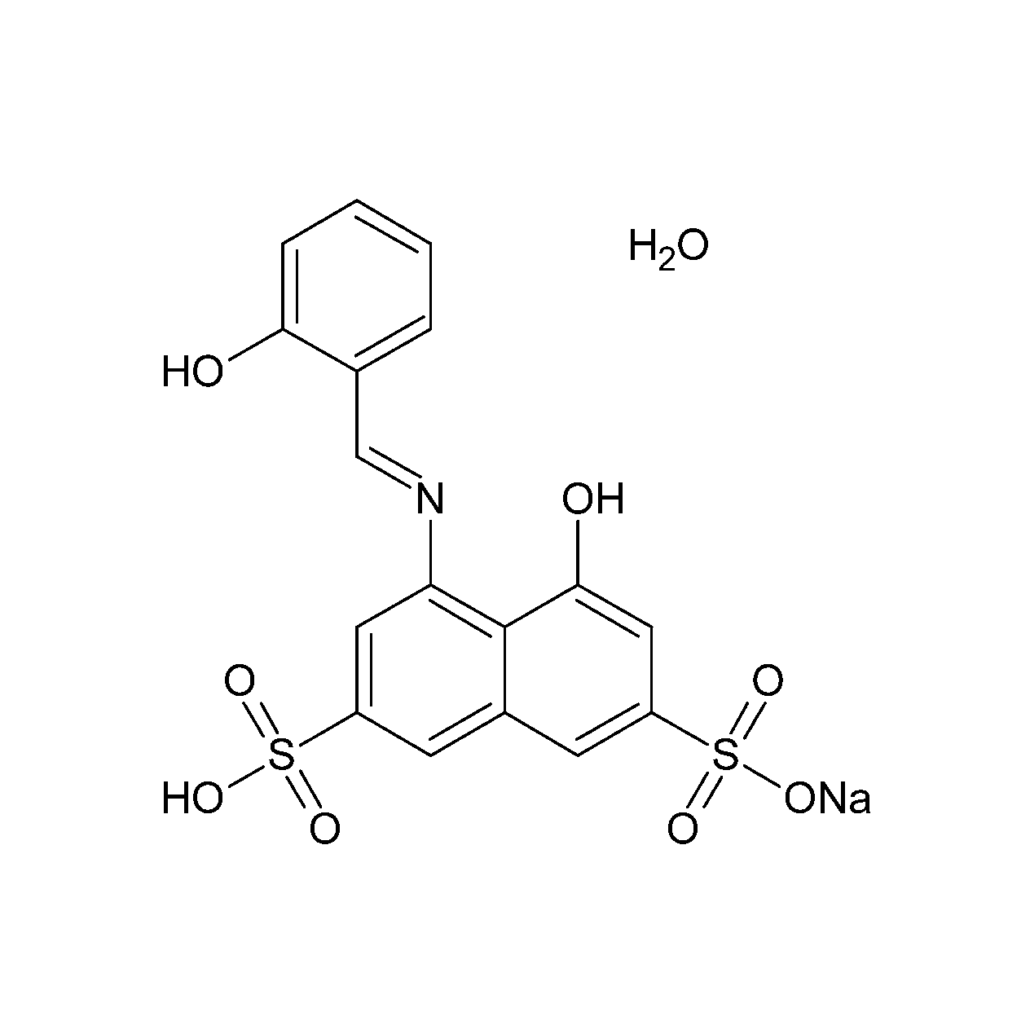
    Azomethine-H monosodium salt hydrate

    Available from stock

      Inquiry

      Please fill out the form for your inquiry:


      * required field

      Azomethine-H monosodium salt hydrate

      SKU
      A0149

      Category: Non Fluorescent Detection & Chromogene Detection

      Synonyms
      4-Hydroxy-5-(2-hydroxybenzylideneamino)-naphthalene-2,7-disulfonic acid monosodium salt hydrate , 4-Hydroxy-5-(salicylideneamino)-2,7-naphthalenedisulfonic acid monosodium salt
      206752-32-1
      CAS-Number
      C17H12NNaO8S2 . xH2O
      Molecular Formula
      445.40 (anhydrous basis)
      Molecular Weight

      For Research Use Only. Not Intended for Diagnostic or Therapeutic Use.

      • Product Data
      • Handling
      • Safety Information
      • Details

      Specifications

      Purity
      ≥95% (T)
      Appearance
      Yellow to orange powder
      Identity
      1H-NMR

      Properties

      Solvents
      water, ethanol, acetone
      Melting Point
      >300 °C
      Other
      Los on drying ≤ 2%, UV specs

      Documentation

      Safety Data Sheet (SDS)
      CDX A0149 MSDS.pdf
      Shipping
      AMBIENT
      Short Term Storage
      RT
      Long Term Storage
      RT
      Handling Advice
      Protect from light and moisture.
      Use / Stability
      Stable for at least 2 years after receipt when stored at RT.
      Hazard statements
      H315-H319-H335
      Precautionary statements
      P261-P305 + P351 + P338
      GHS Symbol
      GHS07
      Signal word
      Warning
      Transportation
      Not dangerous goods
      Description
      Probe for the colorimetric determination of boron in samples such us soils, plants, composts, manure, water, nutirent solution, glass or steel (microgram levels of boron). It forms an orange complex with boron in aqueous solution (absorption maxima at ~415nm). The detection range of boron in sample solutions is 1.0-6ppm. To detect boron in plant samples EDTA is used to mask copper, iron and aluminium ions. It is also used in electrocyclization reactions in the synthesis of martinellic acid, spirotryprostatin A and benzodiazepinones. Was shown to produce free radicals and might have anti-malarial and anti-cancer properties.
      Smiles
      OC(C=CC=C1)=C1/C=N/C2=CC(S(=O)(O)=O)=CC3=CC(S(=O)([O-])=O)=CC(O)=C23.[Na+].O
      InChi Key
      AAIGDXDVSZJVSW-IFJQNBRBSA-M
      References
      (1) W.D. Basson, et al.: Analyst 94, 1135 (1969) , (2) R.R. Spencer & D.E. Erdmann , Environ. Sci. Technol. 13, 954 (1979) , (3) R.A. Edwards , Analyst 105, 139 (1980) , (4) M. Zenki, et al.: Fresenius J. Anal. Chem. 334, 238 (1989) , (5) J. Ciba & A. Chrusciel , Fresenius J. Anal. Chem. 342, 147 (1992) , (6) E.L. Novelli, et al.: Free Radic. Res. 26, 319 (1997) , (7) A. Gross, et al.: Chemosphere 72, 400 (2008) , (8) E. Merdivan, et al.: Spectrochim. Acta A Mol. Biomol. Spectrosc. 71, 2045 (2009)

      Probe for the colorimetric determination of boron in samples such us soils, plants, composts, manure, water, nutirent solution, glass or steel (microgram levels of boron). It forms an orange complex with boron in aqueous solution (absorption maxima at ~415nm). The detection range of boron in sample solutions is 1.0-6ppm. To detect boron in plant samples EDTA is used to mask copper, iron and aluminium ions. It is also used in electrocyclization reactions in the synthesis of martinellic acid, spirotryprostatin A and benzodiazepinones. Was shown to produce free radicals and might have anti-malarial and anti-cancer properties.

      SKU: A0149 Category: Non Fluorescent Detection & Chromogene Detection
      • Additional information

      Additional information

      Synonyms

      4-Hydroxy-5-(2-hydroxybenzylideneamino)-naphthalene-2,7-disulfonic acid monosodium salt hydrate, 4-Hydroxy-5-(salicylideneamino)-2,7-naphthalenedisulfonic acid monosodium salt

      Purity

      ≥95% (T)

      Appearance

      Yellow to orange powder

      CAS-Number

      206752-32-1

      Molecular Formula

      C17H12NNaO8S2 . xH2O

      Molecular Weight

      445.40 (anhydrous basis)

      Identity

      1H-NMR

      Solvents

      water, ethanol, acetone

      Melting Point

      >300 °C

      Other

      Los on drying ≤ 2%, UV specs

      Smiles

      OC(C=CC=C1)=C1/C=N/C2=CC(S(=O)(O)=O)=CC3=CC(S(=O)([O-])=O)=CC(O)=C23.[Na+].O

      InChi Key

      AAIGDXDVSZJVSW-IFJQNBRBSA-M

      Shipping

      AMBIENT

      Short Term Storage

      RT

      Long Term Storage

      RT

      Handling Advice

      Protect from light and moisture.

      Use / Stability

      Stable for at least 2 years after receipt when stored at RT.

      Hazard statements

      H315-H319-H335

      Precautionary statements

      P261-P305 + P351 + P338

      GHS Symbol

      GHS07

      Signal word

      Warning

      Transportation

      Not dangerous goods

      References

      (1) W.D. Basson, et al.: Analyst 94, 1135 (1969), (2) R.R. Spencer & D.E. Erdmann, Environ. Sci. Technol. 13, 954 (1979), (3) R.A. Edwards, Analyst 105, 139 (1980), (4) M. Zenki, et al.: Fresenius J. Anal. Chem. 334, 238 (1989), (5) J. Ciba & A. Chrusciel, Fresenius J. Anal. Chem. 342, 147 (1992), (6) E.L. Novelli, et al.: Free Radic. Res. 26, 319 (1997), (7) A. Gross, et al.: Chemosphere 72, 400 (2008), (8) E. Merdivan, et al.: Spectrochim. Acta A Mol. Biomol. Spectrosc. 71, 2045 (2009)

      Quantity

      5 g, 25 g, 100 g, Bulk

      Related products

      • Gram’s Crystal Violet Solution

        Gram’s Crystal Violet Solution

        Purity: for microscopyCAS-Number: 548-62-9 (comp.)SKU: G0060

        Read more Show Details
      • 4-Dimethylaminocinnamaldehyde

        4-Dimethylaminocinnamaldehyde

        Purity: ≥98% (HPLC)CAS-Number: 6203-18-5SKU: D0310

        Read more Show Details
      • Carbonate ionophore VII

        Carbonate ionophore VII

        Purity: ≥95% (HPLC)CAS-Number: 222310-82-9SKU: C0131

        Read more Show Details
      • 1-(4-Dimethylamino-phenyl)-2-phenanthridin-6-yl-ethanone

        1-(4-Dimethylamino-phenyl)-2-phenanthridin-6-yl-ethanone

        Purity: ≥98% (HPLC)CAS-Number: 938155-11-4SKU: D0313

        Read more Show Details
      © Copyright - Chemodex AG - Customized Molecules developed in Switzerland
      • Home
      • All products
      • Order and delivery information
      • Disclaimer
      • Privacy policy
      • About this site
      Rhod-2 AMRhod-2 AM5-Amino TAMRA5-Amino TAMRA Scroll to top